
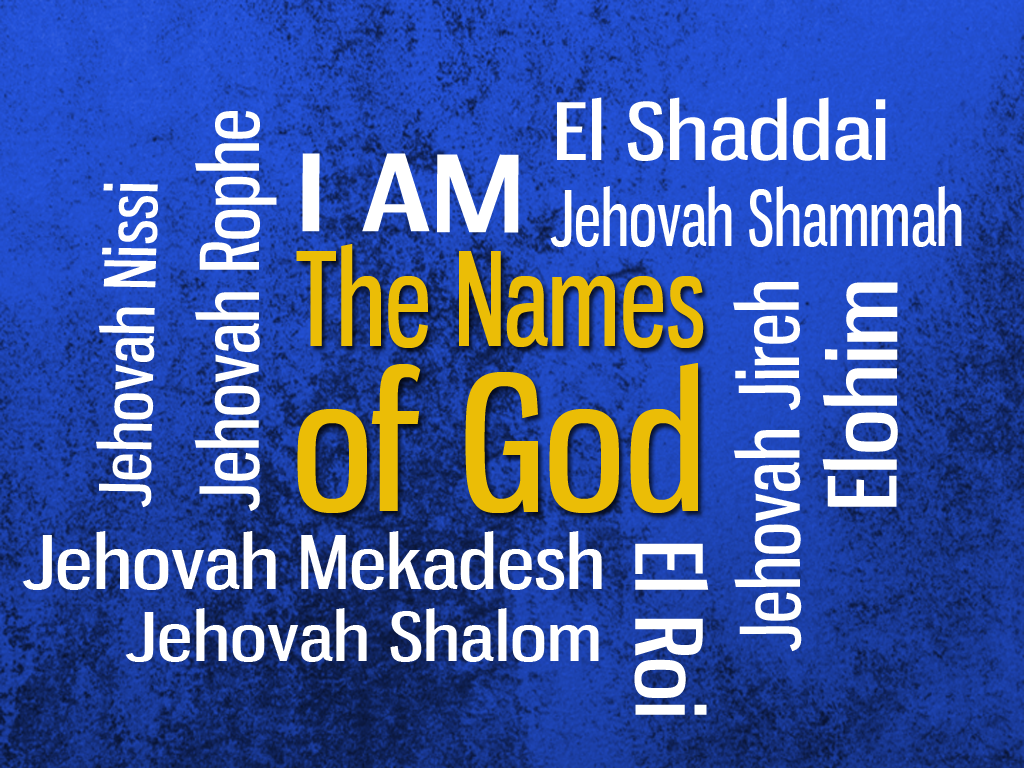
THE NAME / NAMES OF GOD
“I bow down toward Your holy temple and give thanks to Your name
for Your steadfast love and Your faithfulness, for You have exalted
above all things Your name and Your word.” Psalm 138:2
“Therefore also God highly exalted Him, and bestowed on Him the name which is above every name, that at the name of Jesus EVERY KNEE SHOULD BOW, of those who are in heaven, and on earth, and under the earth, and that every tongue should confess that Jesus Christ is Lord, to the glory of God the Father.” Philippians 2:9-11
“And those who know Your name will put their trust in You, for You, O LORD, have not forsaken those who seek you.” Psalm 9:10

I have been blessed through Bible study and the hearing of many sermons on the names of God, especially those of Brian Borgman, the founding pastor at Grace Community Church in Minden, Nevada. Even though I have never met him, his love for and his labor and diligent mining in God’s word have helped me and even encouraged me to labor in God’s word as well. Much of what is written below is summarized from his sermons: The Names of God (Part 1-5). You can listen to them (I highly recommend it!) at sermonaudio.com/gracenevada under the Sermon Series “Systematic Theology”. It is not dull – it will bless you more than you can imagine.
There are a number of practical applications for studying the names of God. We learn why we should honor the LORD’s name and why we should not take the LORD’s name in vain (Ex. 20:7). This would include being jealous for His name – just as He is, and not taking it lightly. Another application, as the third verse listed above says, those who know God’s name will put their trust in Him – our faith in Him is strengthened. It should also be understood that as we learn more about Him, we will trust Him more and more. Learning about His names (Who He is) will also give us a deeper understanding of the Gospel – and what God has done for us through the fulfillment of those names. As Mr. Borgman says, these are “Gospel names” and when we meditate on what He has done for us in His Son Jesus it leads us to praise, adore and worship Him. While this is not a comprehensive list of the practical applications, I would like to close with another application – how learning God’s names will motivate us both in prayer and in missions/sharing the Good News. To see the LORD glorified in prayer and the spreading of the Gospel is the best motivation we could have! It all comes back to glorifying Him who is worthy!
The Bible is filled with many, many names of God, and they all are more precious than the choicest jewels or the finest gold. They are all names that He has revealed to us so that we will trust in Him and He will be glorified. These names are more than titles – they actually explain His character, attributes, and actions – who He is and what He has done. You could say that He is His Name / Names. Or, for those more mathematically inclined: God = His Name / Names. God’s name / names are interchangeable with His glory, His presence and His power. For example, when Moses asks the LORD to show him His glory in Exodus 33:18-23, the LORD responds by saying “I Myself will make all My goodness pass before you, and will proclaim the name of the LORD before you; and I will be gracious to whom I will be gracious, and will show compassion on whom I will show compassion.”
YHWH – YAHWEH
In referring to the Name / Names of God, I’m trying to distinguish between what is considered as His proper name, which He gives in Exodus 3:14-15 YHWH or YAHWEH – I AM and says “This is My name forever, and this is My memorial-name to all generations” and the many other names that He reveals of Himself throughout His holy word, which describe His character, attributes and actions. I intend to expand on these later. This name YAHWEH is derived from the Hebrew word “havah – to be or to exist”. However, it is more than just mere existence. This name actually describes the LORD’s self-existence. He is the one, true and living God. In Revelation 4:8-9, we have a good picture of what YAHWEH means when the living creatures cry out “Holy, Holy, Holy is the LORD GOD, the ALMIGHTY, WHO WAS and WHO IS and WHO IS TO COME.” He is also described as Him who lives forever and ever. YAHWEH had no beginning, no one came before Him. He is the Creator of all things. In Isaiah 40:13-14, the question is asked “Who has directed the Spirit of the LORD, or as His counselor has informed Him? Who has instructed Him or taught Him knowledge or given Him understanding? The answer is – no one.
The name YAHWEH not only has to do with self-existence, but it also has the idea of “I will do what I will do.” As the only one who is self-existent, He is sovereign and free to do as He pleases (Psalm 135:6) He is the potter, we are the clay. This name also has meaning in regards to the covenant that God makes with His people. In Exodus 6, the LORD explains to Moses, that to the forefathers, He revealed Himself as El Shaddai, or God Almighty, but not by His name YAHWEH. The LORD revealing His name of YAHWEH was something new – which entailed the deliverance of His people from their bondage in Egypt. But this would be His name forever. This is ultimately a pointing to Jesus – Who would save His people from their sins! Notice, “I Myself will make all My goodness pass before you, and will proclaim the name of the LORD before you; and I will be gracious to whom I will be gracious, and will show compassion on whom I will show compassion.”
The LORD our God is a jealous God. When we think of jealousy from a human perspective, it generally has a negative connotation. However, in Exodus 2:3-6, we learn that our God is a jealous God – and in Isaiah 42:8 He says “I am YAHWEH, that is My name; I will not give My glory to another, nor My praise to graven images.” It is good that our God is a jealous God! When the LORD led the people of Israel out of Egypt up to the time of David, He would meet with His people in a tabernacle – a tent. David wanted to build a house for the name of the LORD (His presence), which was accomplished by his son Solomon. This was not a house that could contain God, but would be more of a fixed place for God’s presence to dwell. Even the temple wouldn’t last, but it too, like the tabernacle, was a type of the perfect temple that the LORD would provide for Himself – Jesus. In John 1:14 we read “And the Word became flesh and tabernacled among us, and we saw His glory, glory as of the only begotten of the Father, full of grace and truth.” This is amazing to stop and think about! Not only that, but in John 3, when Jesus cleansed the temple of the money changers – it was because of zeal for His Father’s house – or jealousy for the Father’s house or name. When the Jews asked Him for a sign of authority for what He did, He responded with “destroy this temple, and in three days I will raise it up.” The Jews thought He was talking about the temple building, but Jesus was talking about his body.
Speaking of zeal, or jealousy for God’s name, sometimes I wonder if I even have an ounce of what the saints of old had. Like Daniel’s three friends who wouldn’t bow down to Nebuchadnezzar’s statue – even when it could cost them their lives in the fiery furnace. They had such a jealousy for the LORD’s name and His glory that they would not bow and worship anyone except the one, true and living God. Their faith was tested by fire and it remained. The LORD was in the fire with them and delivered them alive. Or consider Paul, when he walked through the city of Athens and observed all of the temples and idols of worship – the scripture says his spirit was so provoked within him that he couldn’t help but make known the one, true and living God and tell the people of Athens the Gospel of Jesus Christ. Do we have such a godly jealousy for the name and glory of our LORD?
Before I go further – in many Bible translations, YAHWEH is shown as LORD in all caps. Also, Jehovah is from the German translation/transliteration of YAHWEH – so when you see Jehovah, it would be the same thing as saying YAHWEH.
YAHWEH Group of Names
YAHWEH RAPHA – The LORD is my Healer. Exodus 15:22-26. The people of Israel had just experienced the deliverance of God through the parting of the Red Sea and the subsequent drowning of the Egyptian army. As they wandered through the wilderness, three days passed with no water. When they finally arrived at a place with water, the water was poisonous and not fit to drink. You can imagine the feeling of the people of Israel. They come to a body of water that they desperately needed to sustain their life and instead it turns out to bring certain death if they drink it. Their immediate thirst was greater than their trust in God by remembering the great deliverance through the Red Sea, so they grumbled against Moses and against God. When Moses cried out to the LORD, the LORD showed him a tree and he threw it into the poisonous waters and they became life giving waters – good to drink. Then the LORD tested the people and said, if they would obey Him and keep His laws and commandments, then He would not put any of the diseases on them that He put on the Egyptians – “for I, YAHWEH RAPHA” – I, the LORD, am your healer.” While we may first think that the LORD is only talking about physical ailments and diseases, we should understand that He addressing something much deeper and more important than that – He is exposing their (our) spiritual condition. While the LORD can and does heal physical diseases, He is not obligated to do so just because we want Him to. His purposes are greater than us. Notice how the people were already grumbling against Him, and they were only about 3 days out from being delivered through the Red Sea! They had only days before been singing praise to YAHWEH for His power, sovereignty and great deliverance, but this death water revealed the unbelief that was in the heart of the people. They praised Him with their mouths, but they didn’t trust Him (this would be a continual pattern of the people of Israel – which the writer of the book of Hebrews says are examples to heed in order to spurn us on to hold fast our belief and trust in YAHWEH, and not fall short). Instead of immediately judging them or striking them down for their unbelief, He said that He would heal them. Notice that the LORD used a tree to make the waters good for drinking. Here we have a picture of the Gospel ultimately pointing to Jesus, who would be hung on a tree (cross). Jesus heals those who come to Him for the living water (and I’m not just talking about their physical thirst), those who believe in His name. In Psalm 103:1-4 the LORD is praised “Bless the LORD, O my soul, and all that is within me, bless His holy name. Bless the LORD, O my soul, and forget none of His benefits; Who pardons all your iniquities, Who heals all your diseases; Who redeems your life from the pit, Who crowns you with lovingkindness and compassion.” In Isaiah 61:1, which Jesus would Himself read to the people it says “The Spirit of the Lord God is upon me, because YAHWEH has anointed me to He actually takes those who are dead in sin, forgives them, heals them and makes them live to Him – praise to His name!
YAHWEH NISSI – The LORD is my Banner (Standard) Exodus 17:8-15
This is the account of the first battle that Israel encountered after they were delivered from Egypt. The Amalekites came out to fight against Israel. Moses sent Joshua to lead the people out to fight against them. Moses took his staff and held it up – while the staff was held up, Israel would prevail. When the staff was lowered, the Amalekites would prevail. Moses hands grew heavy, so Aaron and Hur brought a rock for Moses to sit on while they supported his arms until the sun set. As a result, Israel prevailed against them. At the LORD’s instruction, Moses built an altar and named it YAHWEH NISSI – “The LORD is my Banner” because the LORD has sworn that he would blot out the memory of Amalek from under heaven. When we think of a banner or standard, we should think of something that would be held up as a rallying point or focal point. In this case the people of Israel would remember that it was the LORD who defeated the Amalekites, not the skill of the people. In the New Testament, we see that Jesus was lifted up and sin and death are defeated – He is our banner!
YAHWEH SHALOM – The LORD is Peace (Our Peace) Judges 6:11-24
Here we see Gideon, hiding from the enemy. The angel of the LORD appears to him and says “The LORD is with you, O valiant warrior.” (There is a hint of humor in this passage). It seems from Gideon’s dialogue with the LORD, that he really didn’t know with Whom he was speaking. Once the angel of the LORD departs after Gideon brings a sacrifice, Gideon begins to realize that he is in the presence of the LORD and terror overtakes him. The awesome holiness of the Lord, God Almighty begins to grip him in terror – which it does to every sinner when they encounter the presence of the LORD (consider: Isaiah, who saw a vision of the LORD on His throne and said “Woe is me, I am undone!”; or John on the Isle of Patmos, when the glorified Lord Jesus appears to him and he falls on his face as if dead, or Peter, when after he caught so many fish at Jesus’ command, said “Depart from me Lord, for I am a sinful man.”) Remember what the LORD told Moses, no man can see Me and live! We tend to reserve those thoughts of God inspiring terror to the Old Testament, and we tend to think lightly and casual of God. But that is a mistake. The LORD is holy, just, perfect, and all-powerful; He is the same yesterday, today and forever – He doesn’t change. When sinful man encounters the living God, he knows his end is near. So then, what happened to Gideon? The LORD said to him “Peace to you, do not fear; you shall not die.” Gideon immediately built an alter to the LORD and named it YAHWEH SHALOM, The LORD is Peace. What marvelous words! What Gospel words! Who else spoke those words? The angel’s message to Zechariah and Mary begins with a hint of these words. These are the words we hear Jesus use when he appeared to His disciples in the upper room after His resurrection. “Peace be with you.” This word “shalom” has the idea of wholeness, restoration, harmony, and peace. Sin corrupts man, breaks him down, but the shalom of Jesus restores him, makes the man whole and puts him in harmony with God. Here is another Gospel name – because in Romans 5:1, Paul states “Therefore, having been justified by faith, we have peace with God through our Lord Jesus Christ.” Jesus is our Peace!
YAHWEH SABAOTH – The LORD of Hosts Psalm 24:10 (and numerous other passages)
YAHWEH SABAOTH is the idea that God is the commander of innumerable hosts or armies. The hosts of heaven and earth. He is ruler of everything and above everything. It gives the idea that He is strong and mighty, mighty in battle. As the verse proclaims: “Who is the King of glory? YAHWEH SABAOTH – The LORD of hosts, He is the King of glory.” Revelation 19:11-16 gives a description of Jesus when He comes on a white horse, commanding the armies of heaven, with the name written on His thigh “KING OF KINGS, AND LORD OF LORDS.”
YAHWEH JIREH – The LORD will see to it (will Provide) Genesis 22:1-19
This is a marvelous account of Abraham’s faith, the obedience of his son Isaac, and a demonstration of how the LORD provided a substitute for the sacrifice of Abraham’s son, Isaac (and how He would ultimately provide the substitute sacrifice of His Son, Jesus, to take away the sin of the world!) When Abraham was 99 years old, the Lord promised that he would have a son by his wife, Sarah. The LORD kept his promise and Abraham and Sarah had a son, Isaac. When Isaac was a young lad, the LORD tested Abraham and told him to take his son, his only son, whom he loved and go to the land of Moriah and offer him as a burnt offering on one of the mountains that God would show him. We can only imagine what was going through Abraham’s mind. Surely he remembered the promises that the LORD had made him about his descendants being more numerous than the stars of heaven or the sand on the seashore. But he also had to realize that he would be giving up his only son, his son of the promise, that he loved with a special love. What would he do? Abraham rose up early the next day and made the trip with his son Isaac and some servants. After a three day journey, Abraham saw the mountain that the Lord showed him. He told the servants to wait while he and his son went to worship the LORD and that they would return. Abraham carried the fire and the knife, while the wood for the fire was placed on Isaac’s back (another promised Son would carry wood for the sacrifice on His back many generations later.) When Isaac noticed that they had the items for the sacrifice (except the sacrifice itself), he asked Abraham where the lamb for the burnt offering was. Abraham responded “God will provide for Himself the lamb for the burnt offering, my son.” Abraham prepared the altar and bound his son and laid him on the altar. As he stretched out his hand to slay Isaac, the angel of the Lord called out and said “Abraham, do not stretch out your hand against the lad, and do nothing to him; for I know that you fear God, since you have not withheld your son, your only son, from Me.” Immediately Abraham looked up and saw a ram caught in the thicket. Abraham took the ram and offered him for a burnt offering in place of his son Isaac. Abraham called the name of that place YAHWEH JIREH – The LORD Will Provide. Through this account of Abraham, we can see that we should put our trust in the LORD, because he did provide the ultimate sacrifice for our sins, in the person of His only begotten Son, Whom He loved. The LORD saw to it throughout history that He would send His son at just the right time to die on the cross for the sins of the world. This, too, is a Gospel name. Romans 4:16-17 “For this reason it is by faith, in order that it may be in accordance with grace, so that the promise will be guaranteed to all the descendants, not only to those who are of the Law, but also to those who are of the faith of Abraham, who is father of us all, (as it is written, “A Father of many nations have I made you”) in the presence of Him whom he believed, even God, who gives life to the dead and calls into being that which does not exist. The Lord will see to it!
YAHWEH TSIDKENU – The LORD is Our Righteousness Jeremiah 23:1-8
The pronunciation of this word is like (Sid-KAY-nu)
This passage begins with the LORD pronouncing woe and judgment upon the shepherds for how they are tending His people. They were destroying, scattering and driving away God’s flock. The LORD said that He Himself would gather the remnant of His people from all the countries where they have been scattered and bring them back to their pasture, and cause them to prosper. Then He declares “Behold, the days are coming, when I will raise up for David a righteous Branch; and He will reign as king and act wisely and do justice and righteousness in the land. In His days Judah will be saved, and Israel will dwell securely; and this is His name by which He will be called, “YAHWEH TSIDKENU – The LORD our righteousness.” In chapter 31, the LORD announces that He will make a new covenant, not like the one He made with their fathers when He took them out of the Land of Egypt, which they broke, although He was faithful as a husband to them. But in the new covenant, He Himself will put His law within them and on their heart He will right it, and He will be their God, and they shall be His people. And they will all know Him, from the least to the greatest, for He will forgive their iniquity and remember their sin no more. Here, we have a reference to the requirements of acceptance before God – righteousness. And not just any righteousness, His righteousness. One of the purposes of the old covenant was to expose our sin and our inability to satisfy the requirements of righteousness of a holy God. We are born in sin and are unable in and of ourselves to work out our righteousness. This does not mean that we are all as bad as we can be, but it does mean we are all as bad-off as we can be – we are separated from God. But God, in announcing this new covenant, is saying that He Himself will be our righteousness. He accomplished this by sending His Son, Jesus, the Righteousness of God, to be an atoning sacrifice for the sin of His people. A sacrifice that satisfies the justice of the one, true and holy God. We are talking about justification. Not only are our sins forgiven, but the righteousness of Jesus is credited to us. It is like the greatest accounting transaction that I can think of! (sorry, but that is what I do) Jesus does for us what we could not do for ourselves! There is a poem that is credited to John Bunyan, the author of “A Pilgrim’s Progress” that describes our condition:
Thank You LORD, for Your great and mighty names. May our faith in You increase as we learn and know Your names – for You have exalted above all things Your name and Your word.
I leave us with the following poem:
“Therefore also God highly exalted Him, and bestowed on Him the name which is above every name, that at the name of Jesus EVERY KNEE SHOULD BOW, of those who are in heaven, and on earth, and under the earth, and that every tongue should confess that Jesus Christ is Lord, to the glory of God the Father.” Philippians 2:9-11
“And those who know Your name will put their trust in You, for You, O LORD, have not forsaken those who seek you.” Psalm 9:10
I have been blessed through Bible study and the hearing of many sermons on the names of God, especially those of Brian Borgman, the founding pastor at Grace Community Church in Minden, Nevada. Even though I have never met him, his love for and his labor and diligent mining in God’s word have helped me and even encouraged me to labor in God’s word as well. Much of what is written below is summarized from his sermons: The Names of God (Part 1-5). You can listen to them (I highly recommend it!) at sermonaudio.com/gracenevada under the Sermon Series “Systematic Theology”. It is not dull – it will bless you more than you can imagine.
There are a number of practical applications for studying the names of God. We learn why we should honor the LORD’s name and why we should not take the LORD’s name in vain (Ex. 20:7). This would include being jealous for His name – just as He is, and not taking it lightly. Another application, as the third verse listed above says, those who know God’s name will put their trust in Him – our faith in Him is strengthened. It should also be understood that as we learn more about Him, we will trust Him more and more. Learning about His names (Who He is) will also give us a deeper understanding of the Gospel – and what God has done for us through the fulfillment of those names. As Mr. Borgman says, these are “Gospel names” and when we meditate on what He has done for us in His Son Jesus it leads us to praise, adore and worship Him. While this is not a comprehensive list of the practical applications, I would like to close with another application – how learning God’s names will motivate us both in prayer and in missions/sharing the Good News. To see the LORD glorified in prayer and the spreading of the Gospel is the best motivation we could have! It all comes back to glorifying Him who is worthy!
The Bible is filled with many, many names of God, and they all are more precious than the choicest jewels or the finest gold. They are all names that He has revealed to us so that we will trust in Him and He will be glorified. These names are more than titles – they actually explain His character, attributes, and actions – who He is and what He has done. You could say that He is His Name / Names. Or, for those more mathematically inclined: God = His Name / Names. God’s name / names are interchangeable with His glory, His presence and His power. For example, when Moses asks the LORD to show him His glory in Exodus 33:18-23, the LORD responds by saying “I Myself will make all My goodness pass before you, and will proclaim the name of the LORD before you; and I will be gracious to whom I will be gracious, and will show compassion on whom I will show compassion.”
YHWH – YAHWEH
In referring to the Name / Names of God, I’m trying to distinguish between what is considered as His proper name, which He gives in Exodus 3:14-15 YHWH or YAHWEH – I AM and says “This is My name forever, and this is My memorial-name to all generations” and the many other names that He reveals of Himself throughout His holy word, which describe His character, attributes and actions. I intend to expand on these later. This name YAHWEH is derived from the Hebrew word “havah – to be or to exist”. However, it is more than just mere existence. This name actually describes the LORD’s self-existence. He is the one, true and living God. In Revelation 4:8-9, we have a good picture of what YAHWEH means when the living creatures cry out “Holy, Holy, Holy is the LORD GOD, the ALMIGHTY, WHO WAS and WHO IS and WHO IS TO COME.” He is also described as Him who lives forever and ever. YAHWEH had no beginning, no one came before Him. He is the Creator of all things. In Isaiah 40:13-14, the question is asked “Who has directed the Spirit of the LORD, or as His counselor has informed Him? Who has instructed Him or taught Him knowledge or given Him understanding? The answer is – no one.
The name YAHWEH not only has to do with self-existence, but it also has the idea of “I will do what I will do.” As the only one who is self-existent, He is sovereign and free to do as He pleases (Psalm 135:6) He is the potter, we are the clay. This name also has meaning in regards to the covenant that God makes with His people. In Exodus 6, the LORD explains to Moses, that to the forefathers, He revealed Himself as El Shaddai, or God Almighty, but not by His name YAHWEH. The LORD revealing His name of YAHWEH was something new – which entailed the deliverance of His people from their bondage in Egypt. But this would be His name forever. This is ultimately a pointing to Jesus – Who would save His people from their sins! Notice, “I Myself will make all My goodness pass before you, and will proclaim the name of the LORD before you; and I will be gracious to whom I will be gracious, and will show compassion on whom I will show compassion.”
The LORD our God is a jealous God. When we think of jealousy from a human perspective, it generally has a negative connotation. However, in Exodus 2:3-6, we learn that our God is a jealous God – and in Isaiah 42:8 He says “I am YAHWEH, that is My name; I will not give My glory to another, nor My praise to graven images.” It is good that our God is a jealous God! When the LORD led the people of Israel out of Egypt up to the time of David, He would meet with His people in a tabernacle – a tent. David wanted to build a house for the name of the LORD (His presence), which was accomplished by his son Solomon. This was not a house that could contain God, but would be more of a fixed place for God’s presence to dwell. Even the temple wouldn’t last, but it too, like the tabernacle, was a type of the perfect temple that the LORD would provide for Himself – Jesus. In John 1:14 we read “And the Word became flesh and tabernacled among us, and we saw His glory, glory as of the only begotten of the Father, full of grace and truth.” This is amazing to stop and think about! Not only that, but in John 3, when Jesus cleansed the temple of the money changers – it was because of zeal for His Father’s house – or jealousy for the Father’s house or name. When the Jews asked Him for a sign of authority for what He did, He responded with “destroy this temple, and in three days I will raise it up.” The Jews thought He was talking about the temple building, but Jesus was talking about his body.
Speaking of zeal, or jealousy for God’s name, sometimes I wonder if I even have an ounce of what the saints of old had. Like Daniel’s three friends who wouldn’t bow down to Nebuchadnezzar’s statue – even when it could cost them their lives in the fiery furnace. They had such a jealousy for the LORD’s name and His glory that they would not bow and worship anyone except the one, true and living God. Their faith was tested by fire and it remained. The LORD was in the fire with them and delivered them alive. Or consider Paul, when he walked through the city of Athens and observed all of the temples and idols of worship – the scripture says his spirit was so provoked within him that he couldn’t help but make known the one, true and living God and tell the people of Athens the Gospel of Jesus Christ. Do we have such a godly jealousy for the name and glory of our LORD?
Before I go further – in many Bible translations, YAHWEH is shown as LORD in all caps. Also, Jehovah is from the German translation/transliteration of YAHWEH – so when you see Jehovah, it would be the same thing as saying YAHWEH.
YAHWEH Group of Names
YAHWEH RAPHA – The LORD is my Healer. Exodus 15:22-26. The people of Israel had just experienced the deliverance of God through the parting of the Red Sea and the subsequent drowning of the Egyptian army. As they wandered through the wilderness, three days passed with no water. When they finally arrived at a place with water, the water was poisonous and not fit to drink. You can imagine the feeling of the people of Israel. They come to a body of water that they desperately needed to sustain their life and instead it turns out to bring certain death if they drink it. Their immediate thirst was greater than their trust in God by remembering the great deliverance through the Red Sea, so they grumbled against Moses and against God. When Moses cried out to the LORD, the LORD showed him a tree and he threw it into the poisonous waters and they became life giving waters – good to drink. Then the LORD tested the people and said, if they would obey Him and keep His laws and commandments, then He would not put any of the diseases on them that He put on the Egyptians – “for I, YAHWEH RAPHA” – I, the LORD, am your healer.” While we may first think that the LORD is only talking about physical ailments and diseases, we should understand that He addressing something much deeper and more important than that – He is exposing their (our) spiritual condition. While the LORD can and does heal physical diseases, He is not obligated to do so just because we want Him to. His purposes are greater than us. Notice how the people were already grumbling against Him, and they were only about 3 days out from being delivered through the Red Sea! They had only days before been singing praise to YAHWEH for His power, sovereignty and great deliverance, but this death water revealed the unbelief that was in the heart of the people. They praised Him with their mouths, but they didn’t trust Him (this would be a continual pattern of the people of Israel – which the writer of the book of Hebrews says are examples to heed in order to spurn us on to hold fast our belief and trust in YAHWEH, and not fall short). Instead of immediately judging them or striking them down for their unbelief, He said that He would heal them. Notice that the LORD used a tree to make the waters good for drinking. Here we have a picture of the Gospel ultimately pointing to Jesus, who would be hung on a tree (cross). Jesus heals those who come to Him for the living water (and I’m not just talking about their physical thirst), those who believe in His name. In Psalm 103:1-4 the LORD is praised “Bless the LORD, O my soul, and all that is within me, bless His holy name. Bless the LORD, O my soul, and forget none of His benefits; Who pardons all your iniquities, Who heals all your diseases; Who redeems your life from the pit, Who crowns you with lovingkindness and compassion.” In Isaiah 61:1, which Jesus would Himself read to the people it says “The Spirit of the Lord God is upon me, because YAHWEH has anointed me to He actually takes those who are dead in sin, forgives them, heals them and makes them live to Him – praise to His name!
YAHWEH NISSI – The LORD is my Banner (Standard) Exodus 17:8-15
This is the account of the first battle that Israel encountered after they were delivered from Egypt. The Amalekites came out to fight against Israel. Moses sent Joshua to lead the people out to fight against them. Moses took his staff and held it up – while the staff was held up, Israel would prevail. When the staff was lowered, the Amalekites would prevail. Moses hands grew heavy, so Aaron and Hur brought a rock for Moses to sit on while they supported his arms until the sun set. As a result, Israel prevailed against them. At the LORD’s instruction, Moses built an altar and named it YAHWEH NISSI – “The LORD is my Banner” because the LORD has sworn that he would blot out the memory of Amalek from under heaven. When we think of a banner or standard, we should think of something that would be held up as a rallying point or focal point. In this case the people of Israel would remember that it was the LORD who defeated the Amalekites, not the skill of the people. In the New Testament, we see that Jesus was lifted up and sin and death are defeated – He is our banner!
YAHWEH SHALOM – The LORD is Peace (Our Peace) Judges 6:11-24
Here we see Gideon, hiding from the enemy. The angel of the LORD appears to him and says “The LORD is with you, O valiant warrior.” (There is a hint of humor in this passage). It seems from Gideon’s dialogue with the LORD, that he really didn’t know with Whom he was speaking. Once the angel of the LORD departs after Gideon brings a sacrifice, Gideon begins to realize that he is in the presence of the LORD and terror overtakes him. The awesome holiness of the Lord, God Almighty begins to grip him in terror – which it does to every sinner when they encounter the presence of the LORD (consider: Isaiah, who saw a vision of the LORD on His throne and said “Woe is me, I am undone!”; or John on the Isle of Patmos, when the glorified Lord Jesus appears to him and he falls on his face as if dead, or Peter, when after he caught so many fish at Jesus’ command, said “Depart from me Lord, for I am a sinful man.”) Remember what the LORD told Moses, no man can see Me and live! We tend to reserve those thoughts of God inspiring terror to the Old Testament, and we tend to think lightly and casual of God. But that is a mistake. The LORD is holy, just, perfect, and all-powerful; He is the same yesterday, today and forever – He doesn’t change. When sinful man encounters the living God, he knows his end is near. So then, what happened to Gideon? The LORD said to him “Peace to you, do not fear; you shall not die.” Gideon immediately built an alter to the LORD and named it YAHWEH SHALOM, The LORD is Peace. What marvelous words! What Gospel words! Who else spoke those words? The angel’s message to Zechariah and Mary begins with a hint of these words. These are the words we hear Jesus use when he appeared to His disciples in the upper room after His resurrection. “Peace be with you.” This word “shalom” has the idea of wholeness, restoration, harmony, and peace. Sin corrupts man, breaks him down, but the shalom of Jesus restores him, makes the man whole and puts him in harmony with God. Here is another Gospel name – because in Romans 5:1, Paul states “Therefore, having been justified by faith, we have peace with God through our Lord Jesus Christ.” Jesus is our Peace!
YAHWEH SABAOTH – The LORD of Hosts Psalm 24:10 (and numerous other passages)
YAHWEH SABAOTH is the idea that God is the commander of innumerable hosts or armies. The hosts of heaven and earth. He is ruler of everything and above everything. It gives the idea that He is strong and mighty, mighty in battle. As the verse proclaims: “Who is the King of glory? YAHWEH SABAOTH – The LORD of hosts, He is the King of glory.” Revelation 19:11-16 gives a description of Jesus when He comes on a white horse, commanding the armies of heaven, with the name written on His thigh “KING OF KINGS, AND LORD OF LORDS.”
YAHWEH JIREH – The LORD will see to it (will Provide) Genesis 22:1-19
This is a marvelous account of Abraham’s faith, the obedience of his son Isaac, and a demonstration of how the LORD provided a substitute for the sacrifice of Abraham’s son, Isaac (and how He would ultimately provide the substitute sacrifice of His Son, Jesus, to take away the sin of the world!) When Abraham was 99 years old, the Lord promised that he would have a son by his wife, Sarah. The LORD kept his promise and Abraham and Sarah had a son, Isaac. When Isaac was a young lad, the LORD tested Abraham and told him to take his son, his only son, whom he loved and go to the land of Moriah and offer him as a burnt offering on one of the mountains that God would show him. We can only imagine what was going through Abraham’s mind. Surely he remembered the promises that the LORD had made him about his descendants being more numerous than the stars of heaven or the sand on the seashore. But he also had to realize that he would be giving up his only son, his son of the promise, that he loved with a special love. What would he do? Abraham rose up early the next day and made the trip with his son Isaac and some servants. After a three day journey, Abraham saw the mountain that the Lord showed him. He told the servants to wait while he and his son went to worship the LORD and that they would return. Abraham carried the fire and the knife, while the wood for the fire was placed on Isaac’s back (another promised Son would carry wood for the sacrifice on His back many generations later.) When Isaac noticed that they had the items for the sacrifice (except the sacrifice itself), he asked Abraham where the lamb for the burnt offering was. Abraham responded “God will provide for Himself the lamb for the burnt offering, my son.” Abraham prepared the altar and bound his son and laid him on the altar. As he stretched out his hand to slay Isaac, the angel of the Lord called out and said “Abraham, do not stretch out your hand against the lad, and do nothing to him; for I know that you fear God, since you have not withheld your son, your only son, from Me.” Immediately Abraham looked up and saw a ram caught in the thicket. Abraham took the ram and offered him for a burnt offering in place of his son Isaac. Abraham called the name of that place YAHWEH JIREH – The LORD Will Provide. Through this account of Abraham, we can see that we should put our trust in the LORD, because he did provide the ultimate sacrifice for our sins, in the person of His only begotten Son, Whom He loved. The LORD saw to it throughout history that He would send His son at just the right time to die on the cross for the sins of the world. This, too, is a Gospel name. Romans 4:16-17 “For this reason it is by faith, in order that it may be in accordance with grace, so that the promise will be guaranteed to all the descendants, not only to those who are of the Law, but also to those who are of the faith of Abraham, who is father of us all, (as it is written, “A Father of many nations have I made you”) in the presence of Him whom he believed, even God, who gives life to the dead and calls into being that which does not exist. The Lord will see to it!
YAHWEH TSIDKENU – The LORD is Our Righteousness Jeremiah 23:1-8
The pronunciation of this word is like (Sid-KAY-nu)
This passage begins with the LORD pronouncing woe and judgment upon the shepherds for how they are tending His people. They were destroying, scattering and driving away God’s flock. The LORD said that He Himself would gather the remnant of His people from all the countries where they have been scattered and bring them back to their pasture, and cause them to prosper. Then He declares “Behold, the days are coming, when I will raise up for David a righteous Branch; and He will reign as king and act wisely and do justice and righteousness in the land. In His days Judah will be saved, and Israel will dwell securely; and this is His name by which He will be called, “YAHWEH TSIDKENU – The LORD our righteousness.” In chapter 31, the LORD announces that He will make a new covenant, not like the one He made with their fathers when He took them out of the Land of Egypt, which they broke, although He was faithful as a husband to them. But in the new covenant, He Himself will put His law within them and on their heart He will right it, and He will be their God, and they shall be His people. And they will all know Him, from the least to the greatest, for He will forgive their iniquity and remember their sin no more. Here, we have a reference to the requirements of acceptance before God – righteousness. And not just any righteousness, His righteousness. One of the purposes of the old covenant was to expose our sin and our inability to satisfy the requirements of righteousness of a holy God. We are born in sin and are unable in and of ourselves to work out our righteousness. This does not mean that we are all as bad as we can be, but it does mean we are all as bad-off as we can be – we are separated from God. But God, in announcing this new covenant, is saying that He Himself will be our righteousness. He accomplished this by sending His Son, Jesus, the Righteousness of God, to be an atoning sacrifice for the sin of His people. A sacrifice that satisfies the justice of the one, true and holy God. We are talking about justification. Not only are our sins forgiven, but the righteousness of Jesus is credited to us. It is like the greatest accounting transaction that I can think of! (sorry, but that is what I do) Jesus does for us what we could not do for ourselves! There is a poem that is credited to John Bunyan, the author of “A Pilgrim’s Progress” that describes our condition:
Run, John, run, the law commands
But gives me neither feet nor hands,
But gives me neither feet nor hands,
Far better news the gospel brings:
It bids us fly and gives us wings.
There are many other scriptures that I could include like Romans
5:17-21 to describe the great imputation of Christ’s righteousness to
our account. He alone is our righteousness!It bids us fly and gives us wings.
Thank You LORD, for Your great and mighty names. May our faith in You increase as we learn and know Your names – for You have exalted above all things Your name and Your word.
I leave us with the following poem:
Jehovah Tsidkenu – by Robert Murray McCheyene
I once was a stranger to grace and to God,
I knew not my danger, and felt not my load;
Though friends spoke in rapture of Christ on the tree,
Jehovah Tsidkenu was nothing to me.
I knew not my danger, and felt not my load;
Though friends spoke in rapture of Christ on the tree,
Jehovah Tsidkenu was nothing to me.
I oft read with pleasure, to sooth or engage,
Isaiah´s wild measure and John´s simple page;
But e´en when they pictured the blood sprinkled tree
Jehovah Tsidkenu seemed nothing to me.
Isaiah´s wild measure and John´s simple page;
But e´en when they pictured the blood sprinkled tree
Jehovah Tsidkenu seemed nothing to me.
Like tears from the daughters of Zion that roll,
I wept when the waters went over His soul;
Yet thought not that my sins had nailed to the tree
Jehovah Tsidkenu””´twas nothing to me.
I wept when the waters went over His soul;
Yet thought not that my sins had nailed to the tree
Jehovah Tsidkenu””´twas nothing to me.
When free grace awoke me, by light from on high,
Then legal fears shook me, I trembled to die;
No refuge, no safety in self could I see””
Jehovah Tsidkenu my Saviour must be.
Then legal fears shook me, I trembled to die;
No refuge, no safety in self could I see””
Jehovah Tsidkenu my Saviour must be.
My terrors all vanished before the sweet name;
My guilty fears banished, with boldness I came
To drink at the fountain, life giving and free””
Jehovah Tsidkenu is all things to me.
My guilty fears banished, with boldness I came
To drink at the fountain, life giving and free””
Jehovah Tsidkenu is all things to me.
Jehovah Tsidkenu! my treasure and boast,
Jehovah Tsidkenu! I ne´er can be lost;
In thee I shall conquer by flood and by field,
My cable, my anchor, my breast-plate and shield!
Jehovah Tsidkenu! I ne´er can be lost;
In thee I shall conquer by flood and by field,
My cable, my anchor, my breast-plate and shield!
Even treading the valley, the shadow of death,
This “watchword” shall rally my faltering breath;
For while from life´s fever my God sets me free,
Jehovah Tsidkenu, my death song shall be.
This “watchword” shall rally my faltering breath;
For while from life´s fever my God sets me free,
Jehovah Tsidkenu, my death song shall be.

No comments:
Post a Comment